Andrey Zhikalov / Elma Bureau
Spain does not exist inside an image model as a place. The model has never waited for a late train, walked home through a quiet Valencia neighbourhood or watched a coastal town empty at the end of summer.
Instead, Spain exists as probability.
White façades. Terracotta walls. Blue tiles. Palm trees. Dry mountains. Hard sunlight falling across an empty square. Ask a machine to imagine Spain and these elements return again and again—not because they are false, but because they are familiar.
Synthetic Spain is a visual experiment about that familiarity. It looks at how generative AI compresses a complex country into a small collection of recognisable images, then assembles those images into places that feel convincing even when they have never existed.
The perfect postcard
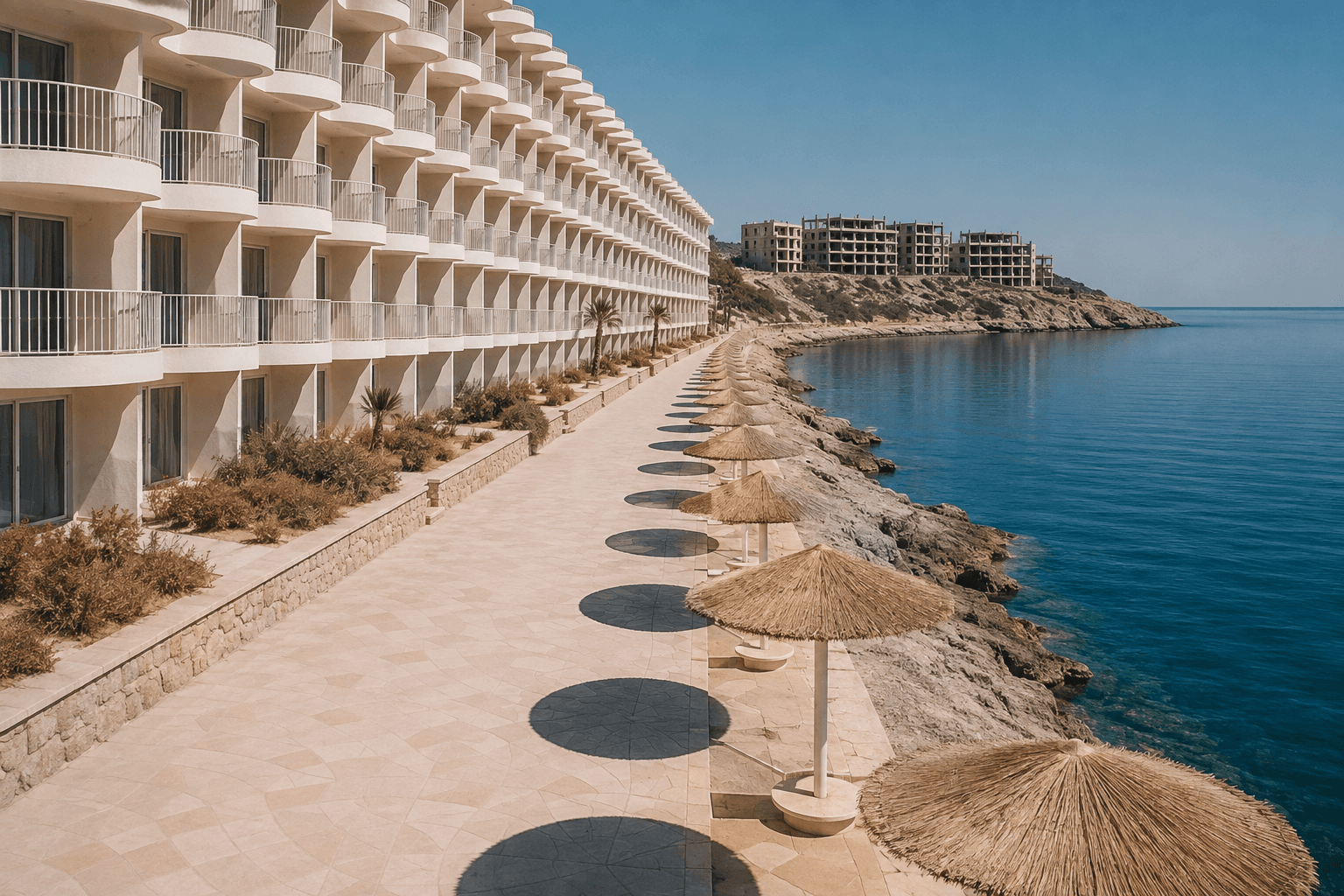
The coast produced by AI is almost too coherent. Balconies repeat without interruption. Parasols create mathematically precise shadows. The sea is permanently calm and the sky contains no weather.
At first glance, the scene feels like an ordinary Mediterranean postcard. Look longer and it becomes less comfortable. Hospitality turns into infrastructure. Architecture becomes repetition. In the distance, unfinished buildings wait for a future that may never arrive.
The image is not a portrait of a real place. It is a composite of thousands of visual conventions: tourism campaigns, property listings, travel photography and decades of construction along the Mediterranean coast.
A country made from materials

ls
When architecture is removed, identity moves into surfaces.
Ceramic blue, sea salt, orange peel, terrazzo, chrome, faded plastic and translucent solar film form an invented material archive. None of these objects explains Spain on its own. Together, they create an immediate sense of place.
This is how synthetic imagery often works: meaning is produced through accumulation. A colour suggests a coast. A texture suggests a decade. A shadow suggests a latitude. The result appears specific while remaining strangely anonymous.
The acceptable future
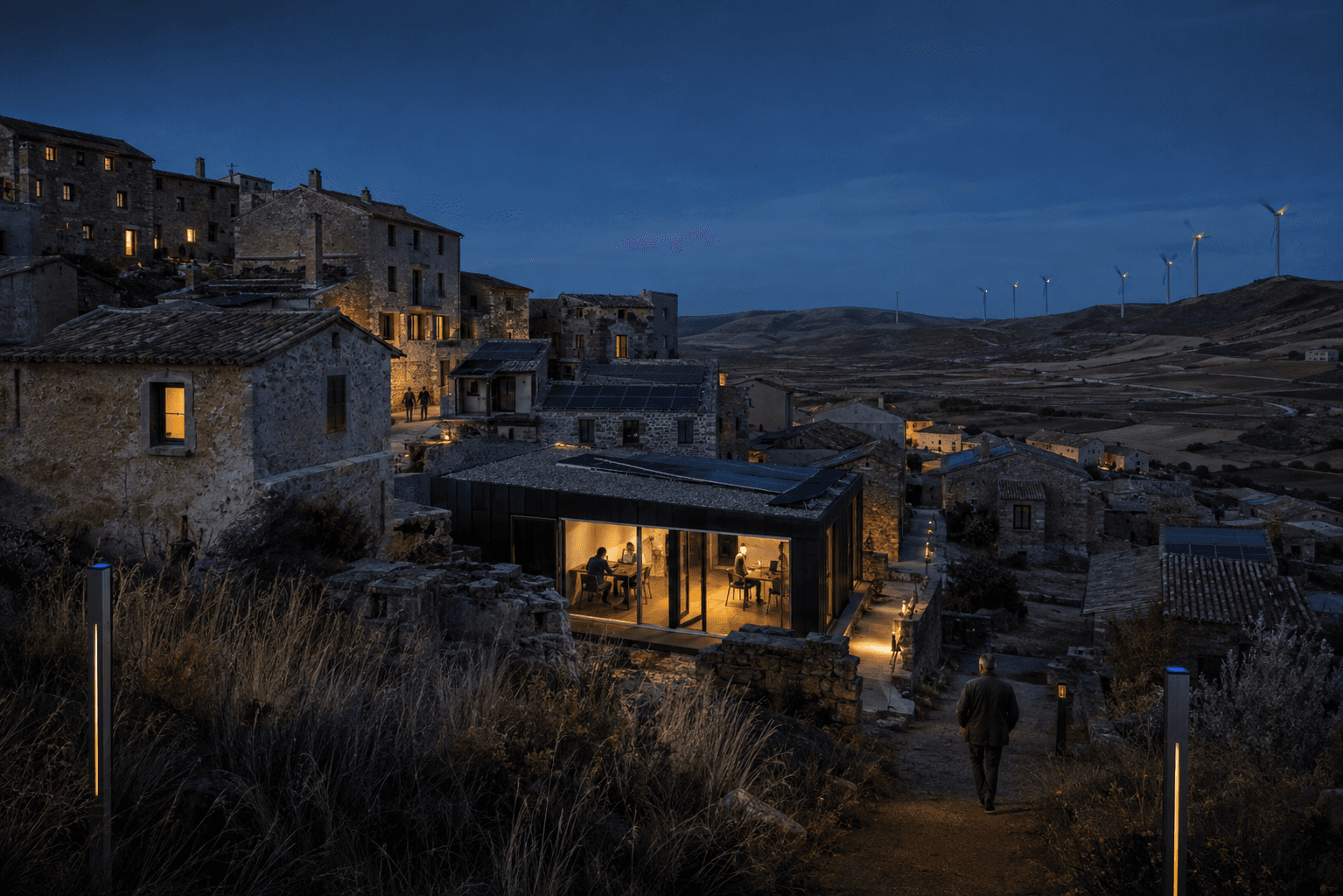
The future imagined by the model is equally familiar. Old stone houses are preserved. Solar panels sit quietly on tiled roofs. A shared workspace glows behind glass. Wind turbines occupy the horizon.
Nothing has been radically transformed. Technology has been added carefully enough to keep the village recognisable. It is a future designed not to disturb the image of the past.
This raises a larger question: when AI imagines progress, does it create new possibilities—or simply update existing aesthetics with a few acceptable symbols of change?
What the image leaves out
Synthetic Spain is beautiful, but incomplete.
There are no supermarkets, logistics parks, schools, hospitals or ordinary apartment corridors. There is little rain, winter or traffic. There are no regional languages, improvised repairs or contested public spaces. The contradictions that make a country real are replaced by visual consistency.
That absence is the most useful part of the experiment.
Generative AI does not remove stereotypes. It makes them efficient. It can reproduce the average image of a place faster than any designer, which makes editorial judgement more important—not less. Prompting creates possibilities, but art direction still requires selection, refusal and context.
Synthetic Spain is not a prediction of the country’s future. It is a mirror made from images of its past and present: polished, persuasive and slightly unreliable.
Perhaps the most interesting future for Spanish design will begin with everything the model does not already recognise.
Synthetic Spain is a self-initiated speculative project by Elma Bureau. The images were generated with artificial intelligence and selected, directed and edited as part of the project’s visual research. It is not commissioned by, or affiliated with, any public institution, municipality or commercial organisation.
Spain does not exist inside an image model as a place. The model has never waited for a late train, walked home through a quiet Valencia neighbourhood or watched a coastal town empty at the end of summer.
Instead, Spain exists as probability.
White façades. Terracotta walls. Blue tiles. Palm trees. Dry mountains. Hard sunlight falling across an empty square. Ask a machine to imagine Spain and these elements return again and again—not because they are false, but because they are familiar.
Synthetic Spain is a visual experiment about that familiarity. It looks at how generative AI compresses a complex country into a small collection of recognisable images, then assembles those images into places that feel convincing even when they have never existed.
The perfect postcard
The coast produced by AI is almost too coherent. Balconies repeat without interruption. Parasols create mathematically precise shadows. The sea is permanently calm and the sky contains no weather.
At first glance, the scene feels like an ordinary Mediterranean postcard. Look longer and it becomes less comfortable. Hospitality turns into infrastructure. Architecture becomes repetition. In the distance, unfinished buildings wait for a future that may never arrive.
The image is not a portrait of a real place. It is a composite of thousands of visual conventions: tourism campaigns, property listings, travel photography and decades of construction along the Mediterranean coast.
A country made from materials
ls
When architecture is removed, identity moves into surfaces.
Ceramic blue, sea salt, orange peel, terrazzo, chrome, faded plastic and translucent solar film form an invented material archive. None of these objects explains Spain on its own. Together, they create an immediate sense of place.
This is how synthetic imagery often works: meaning is produced through accumulation. A colour suggests a coast. A texture suggests a decade. A shadow suggests a latitude. The result appears specific while remaining strangely anonymous.
The acceptable future
The future imagined by the model is equally familiar. Old stone houses are preserved. Solar panels sit quietly on tiled roofs. A shared workspace glows behind glass. Wind turbines occupy the horizon.
Nothing has been radically transformed. Technology has been added carefully enough to keep the village recognisable. It is a future designed not to disturb the image of the past.
This raises a larger question: when AI imagines progress, does it create new possibilities—or simply update existing aesthetics with a few acceptable symbols of change?
What the image leaves out
Synthetic Spain is beautiful, but incomplete.
There are no supermarkets, logistics parks, schools, hospitals or ordinary apartment corridors. There is little rain, winter or traffic. There are no regional languages, improvised repairs or contested public spaces. The contradictions that make a country real are replaced by visual consistency.
That absence is the most useful part of the experiment.
Generative AI does not remove stereotypes. It makes them efficient. It can reproduce the average image of a place faster than any designer, which makes editorial judgement more important—not less. Prompting creates possibilities, but art direction still requires selection, refusal and context.
Synthetic Spain is not a prediction of the country’s future. It is a mirror made from images of its past and present: polished, persuasive and slightly unreliable.
Perhaps the most interesting future for Spanish design will begin with everything the model does not already recognise.
Synthetic Spain is a self-initiated speculative project by Elma Bureau. The images were generated with artificial intelligence and selected, directed and edited as part of the project’s visual research. It is not commissioned by, or affiliated with, any public institution, municipality or commercial organisation.